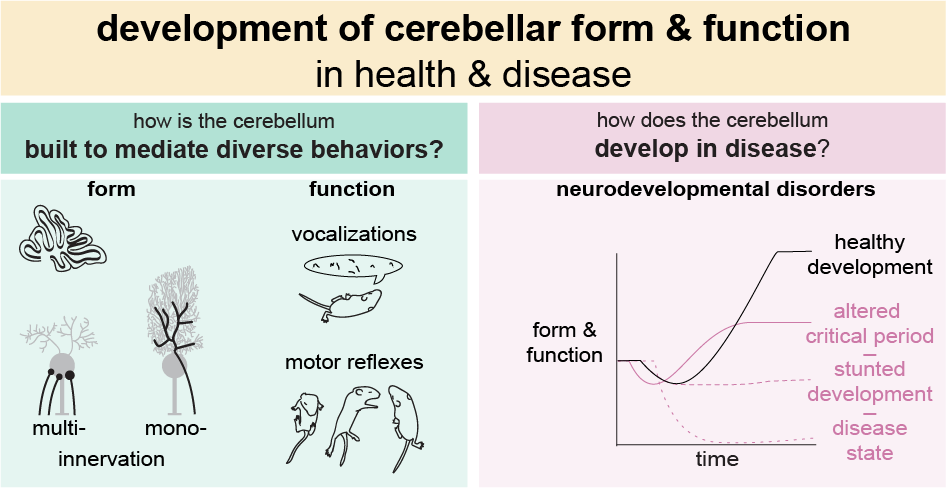
We take a multi-disciplinary approach to study
how cerebellar form shapes function in health and disease.
Our research seeks to understand the relationship between the organization of cerebellar circuits and their function. We investigate cerebellar form across scales—from synapses and individual neurons to circuits and brain-wide networks—and ask how differences in this organization shape neural activity and behavior.
Development provides a unique window into this relationship. As cerebellar circuits are put together, changes in cellular morphology, connectivity, and neural activity transform immature networks into functional circuits. We study these processes to understand how cerebellar form and function become coupled, how the developing brain responds when typical circuit formation is disrupted, and why some alterations produce neurological symptoms while others are remarkably well tolerated.
We also investigate what happens when cerebellar form and function diverge in disease. Using models of movement and neurodevelopmental disorders, we combine neuroanatomy, electrophysiology, and quantitative behavior to connect specific changes in cerebellar organization with changes in neural function and neurological outcomes.
Our overarching goal is to identify the principles that link cerebellar form → neural function → behavior. Understanding these relationships will help us determine why particular circuit abnormalities cause disease, why others permit resilience, and which features of cerebellar structure and activity can be targeted to predict, prevent, or reverse neurological dysfunction.
Learn more about our research from the Big Science, Small Pod podcast.
Learn more about our projects:
Pediatric dystonia
We are funded by NINDS to study how abnormal cerebellar maturation causes early-onset dystonia, a movement disorder characterized by involuntary muscle contractions.
Cerebellar signals in dystonia
We are funded by the Dystonia Medical Research Foundation to study how neural signals in the cerebellar cortex and nuclei can serve as biomarkers or therapeutic targets for dystonia.
Cerebellum in genetic disorders
We are funded through FBRI/Virginia tech pilot awards to study how the cerebellum is altered in 3q29 deletion syndrome and Down syndrome.
Contact us to find out about more current ongoing research projects.
Our work is supported by:




Van der Heijden Lab
We are | We celebrate | We hire | We present
We publish | We share | We study | We teach | Contact us

