We take a multi-disciplinary approach to study
The development of cerebellar function in health and disease.
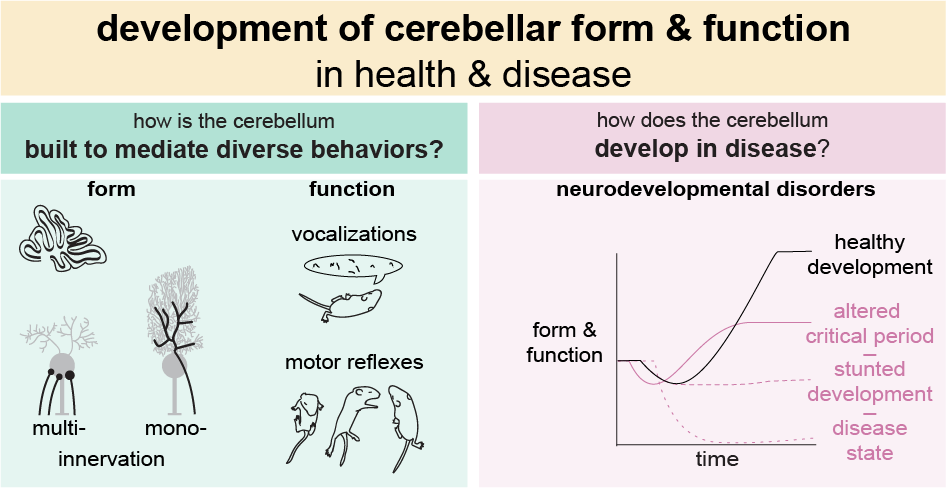
Our research sets out to understand the developmental processes that shape cerebellar function. Developmental perturbations in the cerebellum can lead to motor deficits, as well as impairments in language and social skills. We employ a multidisciplinary approach to elucidate the neuropathological mechanisms underlying cerebellum-associated neurodevelopmental deficits. Our overarching research goal is to uncover specific neuropathological mechanisms for distinct cerebellum-associated disabilities and use our knowledge about healthy maturation to prevent and reverse neurological dysfunction.
Learn more about our research from the Big Science, Small Pod podcast.
Learn more about our projects:
Pediatric dystonia
We are funded by NINDS to study how abnormal cerebellar maturation causes early-onset dystonia, a movement disorder characterized by involuntary muscle contractions.
Cerebellar signals in dystonia
We are funded by the Dystonia Medical Research Foundation to study how neural signals in the cerebellar cortex and nuclei can serve as biomarkers or therapeutic targets for dystonia.
Cerebellum in genetic disorders
We are funded through FBRI/Virginia tech pilot awards to study how the cerebellum is altered in 3q29 deletion syndrome and Down syndrome.
Contact us to find out about more current ongoing research projects.
Our work is supported by:




Van der Heijden Lab
We are | We celebrate | We hire | We present
We publish | We share | We study | We teach | Contact us
 Van Der Heijden Lab