Van der Heijden Lab
We are | We celebrate | We hire | We present
We publish | We share | We study | We teach | Contact us
We study how cerebellar form shapes function in health and disease.
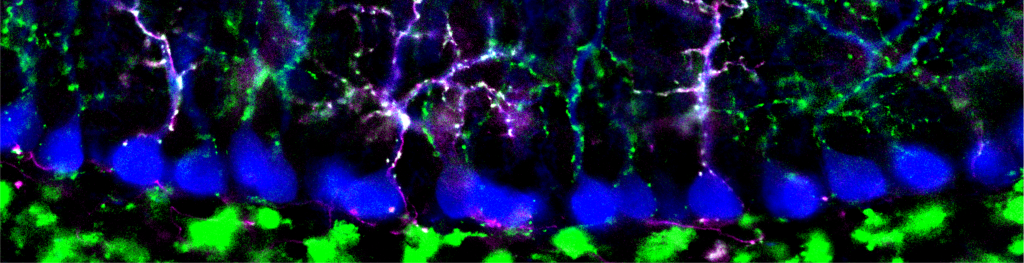
The cerebellum has a remarkably precise architecture. Its cells are organized into highly structured circuits that support movement, as well as cognitive processes including language, and social and emotional processing. We seek to understand how this organization gives rise to cerebellar function—and how changes in cerebellar form alter neural function and behavior in disease.
We study cerebellar form and function across scales, from the organization of synaptic connections and the morphology of individual neurons to neural activity across cerebellar and brain-wide networks. We are particularly interested in how these relationships emerge during development, how they are altered in neurological and neurodevelopmental disorders, and why changes in cerebellar circuitry can lead to very different neurological outcomes.
We want to know: How does the organization of the cerebellum shape what it does? Which changes in cerebellar form lead to neurological dysfunction, and which can the brain accommodate? By answering these questions, we aim to identify the circuit mechanisms that determine neurological outcomes and ultimately uncover opportunities to predict, prevent, and reverse cerebellar dysfunction.
Listen up!

Fralin Biomedical Research Institute | School of Neuroscience | Virginia Tech
Van der Heijden Lab
We are | We celebrate | We hire | We present
We publish | We share | We study | We teach | Contact us

